“I cannot make this any easier; it is not easy. But then, beauty is not ever very easy to find, acquire, nor maintain. That is what is beautiful about it. Beauty demands and requires sacrifice. Sacrifice in time and effort.” George Roland Wills
We have grown accustomed to, and often expect, polished results from minimum effort. But the real thrill of creating beauty comes through some pretty mundane things like setting time aside, being consistent, practicing and practicing and learning from some people who have been around a good long time. Yep, at times it is just plain hard work…but it is worth it. There are no shortcuts to excellence.
Why bother? Excellence stirs, feeds and uplifts something inside us and draws us to experience what someone has created. Whether it is in music, dancing, writing, painting or another art form, we are just naturally drawn to excellence. It is worth the time and effort to be a part of it all…to add our small part to making something that might put a smile on someone’s face or remind them that there are beautiful things in the world.
Beautiful things, in some small way, tell us something about the person who created the work. Likewise, the visible world in all its mind-boggling splendor points to the Great Creator who is the most perfect example of both beauty and sacrifice. Music, dancing, writing, painting and all other kinds of art were His ideas in the first place. The Psalms speak eloquently of these first three artistic expressions listed. And as for painting, well, I like to think that there is a new sunset painted every evening with very large hands. When we strive for excellence, we just give a faint reflection of something higher, deeper and more wonderful than we can imagine.
We live in a world of the quick. Quick smartphones and ipads and computers and information…quick food and rapid results occur in many areas of life. As an artist it took me years to be able to understand and paint with color in a way that can replicate what I see and reproduce the image on canvas. Now anyone can take a color chip to a paint store and a computer can quickly analyze a color and produce a gallon or two for the wall in question. Quick.
We also live in a world flooded with quick images. Need to know what something looks like? Just google it and you can find anything under the sun.
So in such a world, why bother with the time and energy it takes to make beautiful art? And even if we do, since we live in such a “quick world” will people around us even appreciate the effort it took us to make a work of finished art? Why bother?
Creating art is a two-way street; it is a conversation.
There is the artistic journey and what happens within ourselves as we take that one slow step at a time to produce art…and then there is the communication with the viewer.
We are impressed by a thought and learn to translate that idea through an artistic medium – drawing, painting, photography or whatever. In the process we learn and grow cognitively through the experience of creating. And sometimes we end up with something with which we are pleased and we are moved to share it with our corner of the world.
In doing so, we open up the door for discussion. As we express something meaningful to us through artistic means and as we translate those thoughts and images into art, we communicate these visual ideas to others. What and how we paint or draw or create says something about us as individuals, and since it has so much meaning to us we want to share it with others. There is a desire to not only create beauty in art but to also connect with other human beings. And therein lies the value. Positive ponderings, inspiring thoughts, expressions of beauty, nobility, common connections and glimpses of hope are worth the time and effort of our labors. It is worth it for what we learn within ourselves and how by expressing our thoughts through visual means we have the opportunity to provide something uplifting for the enjoyment of others.
The process of learning art is not quick, it takes one slow step at a time, but if used for positive purposes, it is so worthy of our efforts.
“In some spheres the shadow condition is the condition of greatest growth. The beautiful Indian corn never grows more rapidly than in the shadow of a warm summer night. The sun curls the leaves in the sultry noon light, but they quickly unfold, if a cloud slips over the sky. There is a service in the shadow that is not in the shine. The world of stellar beauty is never seen at its best till the shadows of night slip over the sky. There are beauties that bloom in the shade that will not bloom in the sun. There is much greenery in lands of fog and clouds and shadow. The florist has “evening glories” now, as well as “morning glories.” The “evening glory” will not shine in the noon’s splendor, but comes to its best as the shadows of evening deepen.”
From Streams in the Desert by Mrs. Charles E. Cowman
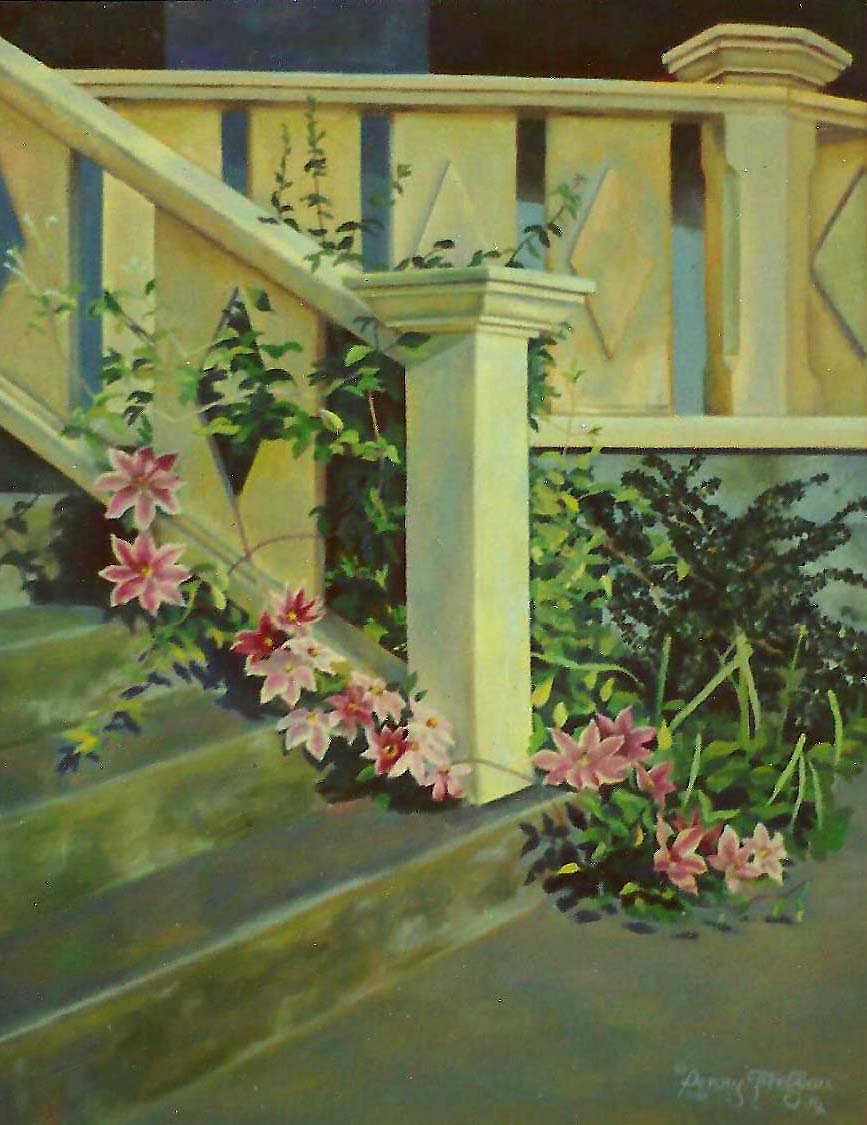
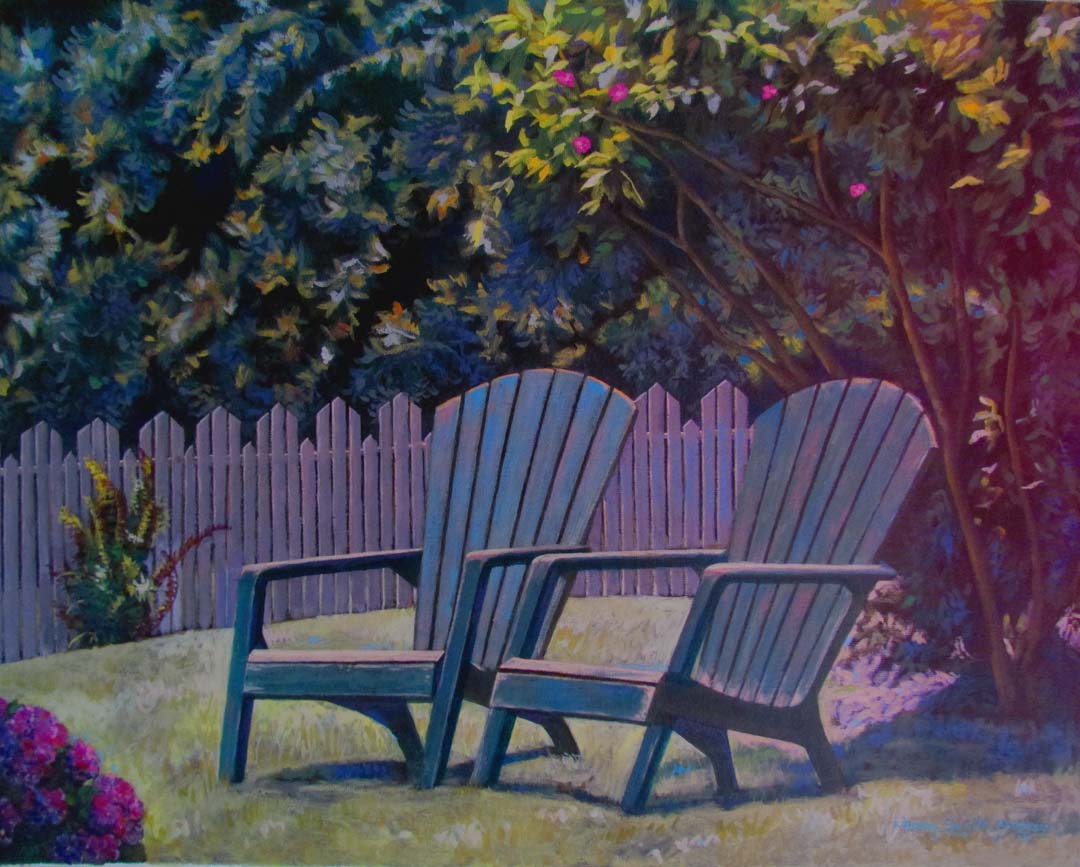
The Impressionists brought the idea to the art world that since light is full of color (consider a prism) that shadows too can come alive through the use of colors that are deep but vibrant. This history-changing group of painters challenged us to look again at the visual life going on in the shadows.
Shadows in life and in art are typically synonymous with the idea that the darkened shade is merely a grayed over area that isn’t as pretty as the bright sunshine, and to an extent that is true. In Humboldt County it typically rains so much that we want to run outside and dance around when sunshine appears in the winter. There are many more sunflowers made memorable in paintings than all the shade plants put together. Yet, when we stop and consider the lush ferns, the fabulous begonias and the intensely colored fuchsias we can begin to understand that these magnificent beauties can only be vibrant in the shade. They too, are worth our attention. The shadowed areas on the canvas are to be considered a part of the composition as the sunlit portions if we want a complete picture.
If life is hard today and you feel like you are living in the shadows remember that the place of darker hues can also be a place of vibrance and growth.
In the hands of the Master Gardener and Great Creator every corner of the garden can bloom with meaningful life in its designated season.
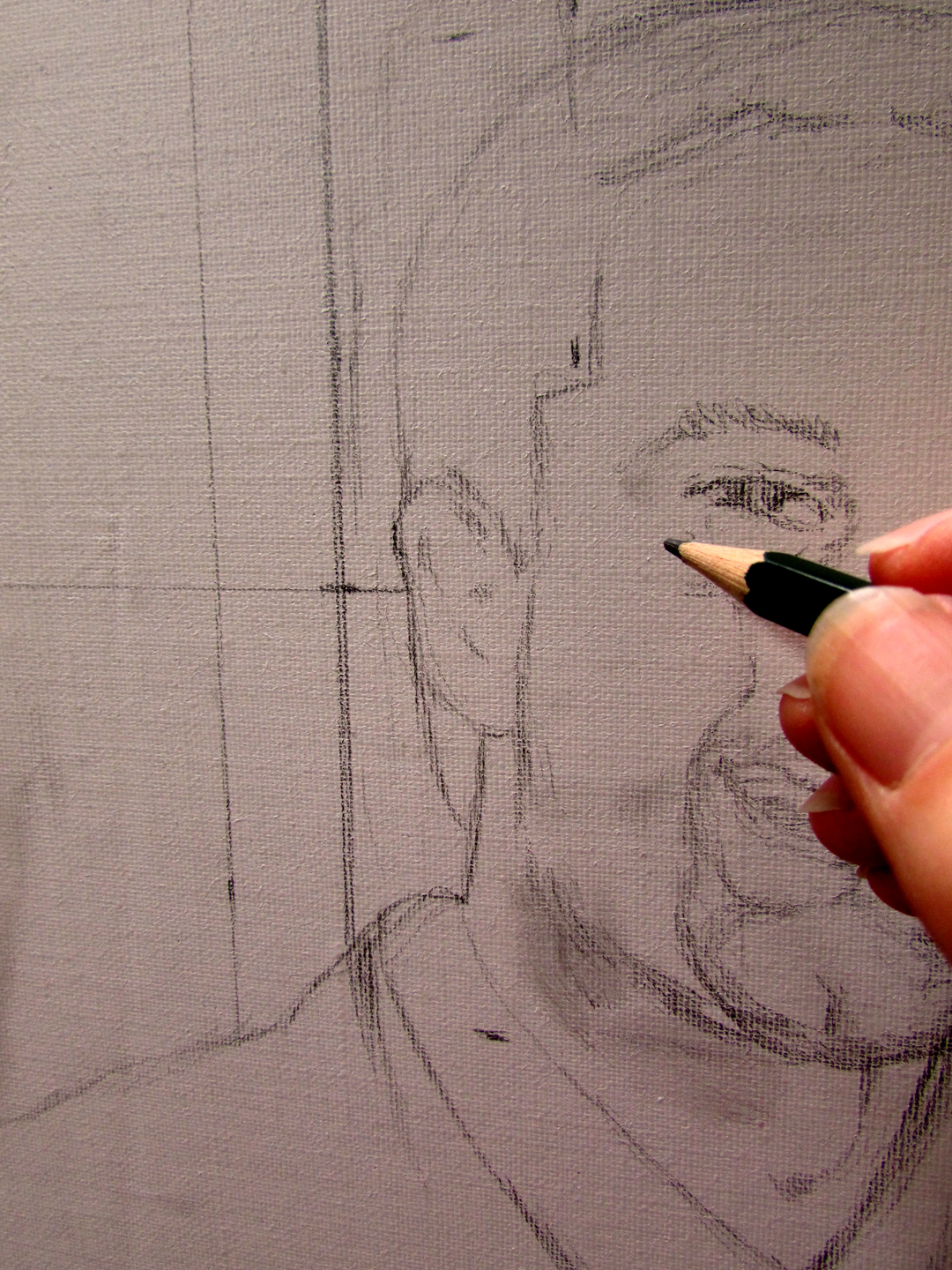
A common exercise to help train the artist’s eye is to enlarge the image of a photograph by using a grid method wherein a picture is sectioned off. A corresponding larger piece of art paper or canvas is similarly sectioned off in proportion, simply larger. Then the student-artist concentrates on one square at a time noting where the line(s) meet the edge of the square and then focus on details that may have been glossed over before that time of careful observation.
Working on a grid slows us down! Like it or not we have to really observe each little line and how they interact with other lines in order to recreate the image in a larger format.
There are many details in life we tend to gloss over until we slow down and really observe. Yes little things are often the big things as they say. Those little nuances can have a mighty effect over the whole.
Sometimes life’s boundaries and grids, annoying as they can be, can help us more than we can imagine.
A grid study can point out quickly that we are pouring our energies into the wrong area. The picture, as nice as it may be, may simply be started in the wrong place, and if we continue ignoring the yellow lights that the boundaries provide, the picture will never come up to our high expectations.
So what do we really learn from the boundaries and grids of life? In a piece of art we learn that the careful observation of a subject is worthwhile because we not only learn how to render that particular image with increased accuracy, we gain knowledge that will help us on our next artistic endeavor.
Similarly, in life we learn that sometimes those ‘boundaries’ and ‘grids’ that are imposed upon us and appear to be just blocking our way from our goals – really are useful instruments that point to some little things that may need an extra look.
A year ago I changed careers and then life met me with a series of grids that I never could have predicted. It has not been an easy year, but I sure have learned a great deal about pictures and more importantly about life from slowing down and considering what is truly important. I found myself doing lots of projects and tasks that I didn’t have to deal with when life was fast-paced and seemingly productive. But the boundaries and grids placed before me became a framework on which to climb on and grow. Even though I would prefer not to have to deal with those encumbrances, I cannot deny that they have helped to reproduce a larger life than I ever could have imagined. By taking one square at a time and slowing down and really focusing on one line at a time I learned, and am learning, to persevere until the image becomes complete.
Do you have a boundary or grid before you in your art class or in your life? Don’t be discouraged. You are going to learn a lot! It will be worth it in the end!
A young beginning painting student starts mixing colors.
“Inspiration” is defined by the American Heritage Dictionary of the English Language in the following way:
“1. a. Stimulation of the mind or emotions to a high level of feeling or activity.
b. The condition of being so stimulated.
2. An agency, such as a person or work of art, that moves the intellect or emotions or prompts action or invention.
3. Something, such as a sudden creative act or idea, that is inspired.
4. The quality of inspiring or exalting: a painting full of inspiration.
5. Divine guidance or influence exerted directly on the mind and soul of humankind. ..”
So where do we go or what do we do to tap into this “well of creativity”… this “inspiration”? Oh, we can all point to moments when the thrill of something we saw, perhaps on a majestic mountainside or something we heard, in a hall of great music, sparked a flow of creativity. That experience caused us to delve into our chosen creative endeavor – writing, drawing, painting, filmmaking, quilting, house-building, music-making – whatever it may be with renewed enthusiasm. The avenues of creative expression are varied and broad and it never ceases to amaze me how people conceive such extraordinary things!
So, how do they do it?
We “get” those mountain peak moments, but a level of creative endeavor that produces enough of those inspiring moments to nurture other creative spirits must come from a deeper well than the occasional outbursts of motivation.
How does the beginner muster the emotional energy and confidence to embark on a creative endeavor, or how do those seasoned individuals in the creative fields drum up enough stimulation time after time after time to persevere?
I speak not as an expert, but as a follower sojourner walking the road through the creative fields. From this point of view I would put forth the unlikely and perhaps scary word called discipline.
Discipline? You say…what an uninspiring word!
Not so! The Olympic athlete, the talented violin virtuoso and the successful novelist do not arrive at their lofty destinations by a continual string of inspirational moments but rather by a determination to keep going, to keep trying, to start again, perhaps failing many times along the way – but learning a little more for each effort. They persist and that takes an enormous amount of discipline.
And so inspiration, for all its head-in-the-cloud moments often comes down to putting one foot in front of the other, casting one’s eye on the goal and summoning the courage to start again.
We may think it is the achievement of other we are admiring in their wildly creative endeavors, but at the core of the matter it is more likely that we are admiring the ability to keep on going and not losing heart.
And as for the ability to not lose heart, I would personally point to the fifth dictionary definition and recognize that help from above. For it is not merely a matter of the “mind,” but rather of the “mind AND soul” that that allows one to tap into that truly inexhaustible well of creativity.
A painted Easter lily, detail from Resurrection Lilies
The direct method of enlarging a picture by observing its major geometric shapes, the relation of those shapes to each other, the negative spaces they create and paying attention to the way the light illuminates the shapes to create forms is said by another way in a simple but overused sentence:
Look at the big picture.
If you are like me you can easily get sidetracked and bogged down by the details. In fact, details are so enjoyable that one can easily focus on the details that the major emphasis of the picture is lost by the mastery of creating details. You know if you fall into this category of artist if:
You create a poster and enjoy the picture so much that you minimize or even forget the headline text that draws people to the event.
You have a compulsion to draw or paint every eyelash in a portrait.
Working with a magnifying glass is exciting, rather than tedious.
magnifying glass (Photo credit: Wikipedia)
Small teeny tiny brushes are considered some of your best painting tools.
You sharpen drawing pencils constantly so that you only draw with a very sharp point.
For those of us who love details, pushing ourselves to observe the big picture is not something that comes naturally. But push ourselves, we must. Let’s consider this on a little deeper level and expand our thinking.
What do you want to communicate in this drawing or painting?
What about this subject appeals to you?
What do you think the selection of this subject (or the way it is drawn or painted) says about you?
Do you have a memory you associate with this subject?
How is your outlook on life reflected in this piece of art?
Now, as you work on this piece of art, make it your practice to step back twenty feet every 15 – 30 minutes.
How does this change your perspective?
Has this improved your art?
What insights about your creative process do you glean from having answered these questions?
Two “tools” from the toolbox of the artist who is a life-long learner are:
Observe and grow in skill from focusing on the details.
Make stepping back and gaining perspective from the big picture a part of your working routine.
“Unless you try to do something beyond what you have already mastered, you will never grow. Every job is a self-portrait of the person who did it … Autograph your work with excellence.” ― Vince Lombardi
In the process of art and the process of life there is great value in just sticking to it, and be encouraged in step-by-step progress.
The basics seem so boring. When I finally reached college age I was so excited not to have to take, what I considered, the boring curriculum subjects of math, science and foreign language and jumped at the chance to select more creative endeavor. And so, in my first season of college I took drawing, design, interior decorating, ceramics, quilting, creative writing, piano and guitar. You should have seen the look on my father’s face, (who was paying for all these classes). It’s not that he objected to any of them – he greatly encouraged my creativity! However, as a mature person, he could understand that I would need to complete those general education basics. These basics would enable me to accomplish educational goals that would allow me to have freedoms in life choices in careers and expand avenues to allow my creativity to flourish.
And so, I took the long way and had to take all those more difficult, yet basic, courses at the end, all at the same time. It was an example of what not to do. Sometimes we learn the hard way.
I would like for you to benefit from my mistakes and embrace learning the basics. Because it is in the mastery of basic skills that excellence has the opportunity to blossom! In this instance the application is in drawing. Drawing forms and lines convincingly, no matter how elementary they may seem, will pave the way for bigger and better accomplishment. Don’t be discouraged with the basics. Like the scene from the Karate Kid movie where painting the white-washed fence over and over gave the young man the freedom to make quick and effective karate moves, drawing simple things well will pay off in the long run.
Well Fall is in the air! As much as we long for summers here on the North Coast because we have such an abundance of rain, still, we tend to greet Autumn with great anticipation as well. There is something about new beginnings, a change in the weather and students going back to school. In our home we have a new Kindergartener which makes for a new chapter of wonder and awe, and that is great fun. I hear people getting excited about pumpkin lattes, baking with apples, cinnamon and of course “pumpkin” everything. One of my favorites is my daughter-in-law’s pumpkin cheesecake. Just thinking about those hearty warm autumn meals to take the edge off of the anticipated first chill in the air makes one hungry.
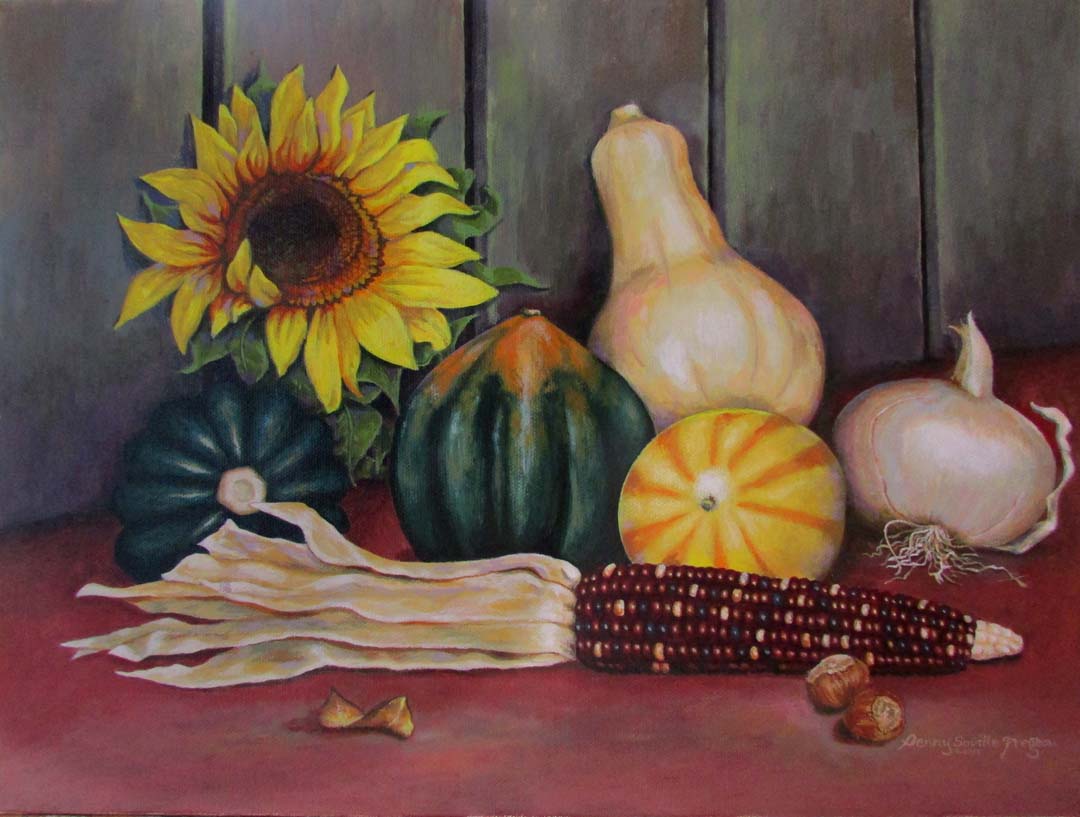
Autumn for the artist is a rich time as well as nature transforms before our eyes from a landscape of greenery into the warm tones of oranges, yellows, golds and reds. Textures abound from the kernels on Indian corn to the knarly crustations on various squash and gourds. We think of things like maple syrup, turning leaves and split wood for fireplaces. There is a wealth of imagery all around us in this season of turning.
In autumn the production of chorophyll, the green pigment in leaves, slows to a halt. Carotenoids and anthocyanins, yellow, orange and dark red pigments, are exposed in the leaves, giving them their characteristic autumnal colors.
It is so interesting to me that the other colors are in a sense already there in the summer when all we can see with our eyes are the green, but when the green pigment is taken away other colors are revealed. Truly ours is a world filled with color and light, and this truth is a glorious banquet for the eyes of the artist who would purposely set about to observe nature more intently.
Something my painting teacher, Jim Faber, (who was a wonderful colorist) said is that in light there is all colors and so when we paint we can attribute color to places that we know, scientifically, are there. For example, we may see only a light yellow in a flower, but knowing that light is full of color we can gently and judicially place other colors of the same value within that yellow, understanding the properties of light.
As I have been reading through the book of Job lately, in 38th chapter, the 14th verse says, “As the light approaches, the earth takes shape like clay pressed beneath a seal; it is robed in brilliant colors.”
And so in Fall classes we will be studying many facets of the tremendous art forms called drawing and painting and a facet will be how this world was created with wondrous color and light. We learn, step by step, how to take in that magnificent visual world around us, and translate it onto canvas or paper to be a beauty and delight to the people in our corner of the world. Happy Fall and happy creating!
New Humboldt County Art Classes are starting mid-September! Acrylic Painting in Fortuna starts Tuesday, September 17th at Fortuna Fabrics and Crafts from 3:30 – 5:30 in the afternoons. Classes are open from ‘pre-teens’ through senior adults – beginners and intermediate welcome. The class runs for 8 weeks. Call 725-2501 to sign up. A Drawing Class starts Thursday, September 19th from 6:30 – 8:30 in the evening at Fortuna Fabrics and Crafts. This class also runs 8 weeks. Sign-up at 725-2501. A Fall Acrylic Painting class is beginning Friday morning from 9:30 AM – 12:30 through College of the Redwoods in Eureka. This class runs for 6 weeks. Contact 269-4008 to sign-up for this class. Supplies are available through Fortuna Fabrics and Crafts in Fortuna and Ellis Engineering in Eureka. All classes are $99 for tuition plus supplies.









 penfrea. com Nehemiah's Art