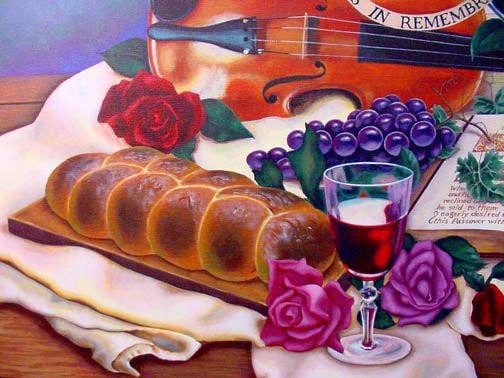
A still life painting with the elements of communion.
Taking the attitude that we are learning and experimenting helps take some of the pressure that we put upon ourselves away. If we consider learning a “win” then we are encouraged. If we are perfectionistic in our expectations then we will certainly become discouraged when our efforts don’t measure up. Personal progress is a reason to propel us on to bigger and greater things.
Along with experimenting and learning, nothing takes the place of hard work. Sure, we want to “work smarter” and feel that there is good value for our efforts. No one wants to feel like they are “wasting time.” But nothing takes the place of plain old determined, dare I say disciplined, hard work.
A line from Proverbs says,
“Ants – they aren’t strong, but they store up food all summer.” (30:25)
A lesson from the lowly ant is that they keep on going. They work and work and it pays off for them. There is great value and dignity in hard work. There is no short-cut for producing fine paintings than the equation time+effort+learning from mistakes = greatly improved work.
Consider this from the greatest artist of all time:
The greater danger for most of us lies not in setting our aim too high and falling short; but in setting our aim too low, and achieving our mark.
The Problem We All Live With by Norman Rockwell, depicting Bridges as she goes to school (Photo credit: Wikipedia)
Motivation is what gets everything started. We have many dreams in our heads of great things we would like to do and feats we think we would like to accomplish. Yet without motivation those perhaps noble thoughts simply do not materialize. There has to be a stronger, higher and deeper reason to motivate us to pursue better outcomes.
Consider this from Michelangelo:
Many believe – and I believe – that I have been designated for this work by God. In spite of my old age, I do not want to give it up; I work out of love for God and I put all my hope in Him.
This was the motivation for Michelangelo to achieve the greatest art mankind would ever produce.
What will be your stronger, higher and deeper reason to motivate you?
“I am never going to have anything more to do with politics or politicians. When this war is over I shall confine myself entirely to writing and painting.”
I find it both fascinating and encouraging, as an artist, that when Churchill moved off of the world stage he chose writing and painting as worthwhile pursuits and recognized, perhaps, the healing quality of such endeavors. No doubt the winds of adversity howled mightily as Churchill had to take a strong stance – often alone – and deal with enormous consequences. But he persevered and we in the west and even the world owe a great debt of gratitude to a man who led the fight against tyranny and said we would never, no never give up. We enjoy freedoms today because someone was willing to put themselves on the line. No doubt in the midst of the turmoil his mind and emotions went through a pummeling that few in the world can ever comprehend.
It was at the end of all this that Churchill chose to pursue writing and painting.
Sir Winston Leonard Spencer Churchill, by Ambrose McEvoy (died 1927). See source website for additional information. This set of images was gathered by User:Dcoetzee from the National Portrait Gallery, London website using a special tool. All images in this batch have been confirmed as author died before 1939 according to the official death date listed by the NPG. (Photo credit: Wikipedia)
The sensitivity it takes to observe the visible world and also sense it’s unseen qualities, take it all in and then carefully craft words or pictures that interpret things that are “true, honorable, right, pure, lovely, admirable, excellent and worthy of praise”* is something that benefits others. However this same sensitivity feels intense pain when life is difficult and is heavily weighted down by life’s trials. One cannot escape the fact that this sensitivity is both beneficial and, if not dealt with in a healthy way, injurious to one’s own health and mental well-being.
Churchill was wise then in acknowledging that there needed to be a break in the seasons of life. After intense years of pressure there needed to be years of meaningful, yet reflective contemplation.
The wisest man that ever lived, Solomon, wrote these words:
For everything there is a season,
A time for every activity under heaven.
A time to be born and a time to die.
A time to plant and a time for harvest.
A time to kill and a time to heal.
A time to tear down and a time to build up.
A time to cry and a time to laugh.
A time to grieve and a time to dance.
A time to scatter stones and a time to gather stones.
A time to embrace and a time to turn away.
A time to search and a time to quit searching.
A time to keep and a time to throw away.
A time to tear and a time to mend.
A time to be quiet and a time to speak.
A time to love and a time to hate.
A time for war and a time for peace.
Ecclesiastes 3:1-8
In this season of artistic endeavor, if you are in a time of tumultuous adversity or in that season of peace, may you find comfort and nurture of soul in times spent in taking in the beauty of the visual world and interpreting it for the uplifting of others and the healing balm of your own heart.
A detail of painting “Colour My World: features roses on a piano with music and a violin.
Perseverance often means a dogged determination to master the basics. For we know that as we build that solid foundation, in the field of our endeavor, our greatest opportunity for full artistic expression is given flight. The very repetitious and mundane practices of our craft coupled with an intellectual thirst to learn more create within us building blocks of skilled knowledge that we can pull out and use as needed. It is of great value in the long run to spend the time and energy to make a solid foundation on which to build.
A painter’s execution bears the stamp of his personality at every point and his emotional expression is strictly limited and shaped by his technical equipment.”
MICHELANGELO Buonarroti Study for the Libyan Sibyl Chalk on paper, 29 x 21 cm Metropolitan Museum of Art, New York (Photo credit: Wikipedia)
To express oneself fully it is essential to develop ones skills by learning the time-honored basics of art. This necessitates practice, patience, intellectual work and taking the long view. We can both celebrate progress along the way and dedicate ourselves to bigger and better things in the future.
“For fine pictures do not just happen. They are the result of careful though and profound knowledge intelligently applied to the solution of an artistic problem.” – R.H. Ives Gammell, Twilight of Painting
And from the greatest human artist that ever walked planet earth:
“If people knew how hard I worked to get my mastery, it wouldn’t seem so wonderful at all.” – Michelangelo
And so we ask, what things do we need to learn to “shape our technical equipment?” What are the “time-honored basics of art?”
“…the very things which for centuries have been considered, by artists and picture lovers alike, essential qualities of that art. Beautiful workmanship, fine drawing, balanced composition, the sensitive rendering of the phenomena of the visible world….” – R.H. Ives Gammell, Twilight of Painting
“The building blocks of art: order, harmony, proportion, unified variety, dominance, form, and so forth, are simply the principles inherent in physical reality, all of which reflect the character of the One who created it.” Stephen Gjertson, Timeless Treasure
Sensitive rendering of the phenomena of the visual world
Order
Harmony
Proportion
Unified Variety
Dominance
Form
As Gjertson alluded, the “basics” in creating fine representational art mirror the natural visual world and in turn reflect the Great Creator who spoke the world into existence. By observing and seeking to replicate what we see in nature in our artwork we learn both the skills of creating better art and an appreciation of the work of the Master Artist.
Perseverance is often in the “trifles ” of art. Perseverance, which is often putting one foot in front of the other, is a mark of strength and grace in one’s life.
“Trifles make perfection, and perfection is no trifle.” – Michelangelo
The Christian concept of apocatastasis includes a restoration of the world to its original state, as in the Garden of Eden (Photo credit: Wikipedia)
As Michelangelo well knew, there was only one perfect Master Artist, and Michelangelo sought to imitate His work. The Master Artist’s original, the Garden of Eden, was that place of perfect beauty, harmony and order. The rest of us fall far short, but can learn great lessons from His creative hand. The natural world, where the building blocks of art continue to exist, visually shouts out glorious beauty and as we observe and take in those sacred lessons, our artwork is well improved, and given expression.
A painted Easter lily, detail from Resurrection Lilies
Some of our days, or seasons of our life, can be like dramatic contrast in a painting. There are portions of brilliant light juxtaposed by deep dark shadows – the peaks and valleys of life sometimes run close together. In my work in ministry there were weeks when we would both prepare for a wedding, with all the joyous celebration of a couple’s new life together, and just days later work alongside family members who were saying their final good-byes to a loved one when death stepped forward drew its line in the sand. High contrast.
Then there are season – days, weeks, months, even years – when everything seems to run together. Nothing changes, it’s all the same…or at least on the surface. Those are days of like value. There is a consistency to the climate of the painting – it is all relatively the same. Yet, herein is the lesson.
2nd third of 19th century (Photo credit: Wikipedia)
When we approach a painting, or the days of our lives in a quiet season, the value can be either monotonous or vibrant depending on the use of value. Multicolored hues of the same value can be used on the canvas to make a visual symphony with interest in every stroke. A painting of this nature is compared to a life that, although no great drama, has stunning beauty because the values of intellect, physical action, and rich spiritual nourishment coincide in harmony side-by-side. Conversely, if a painting has no thought as to the placement of value in color, it will be dull, without life and immature in concept…and life is the same. If we put forth no action toward the things which make us uniquely human – our intellects, our physical capabilities, our skills, talents and things of the spirit, then life would be boring indeed. But it need not be – there is always a choice.
Michelangelo Buonarroti (Photo credit: Wikipedia)
The greater danger for most of us lies not in setting our aim too high and falling short; but in setting our aim too low, and achieving our mark. – Michelangelo
A composition, in many aspects, is the task of placing visual components on a canvas. This may sound simple but may be, in fact, amazingly complex. The arrangement of objects can convey diverse ideas and one has to decide what one is attempting to communicate to the viewer. For example, a simple triangular composition with a long side parallel to the bottom of the canvas conveys stability, strength and security. We see the basis of this composition in paintings like Michelangelo’s Holy Family. There is much more thought behind composition than we initially recognize. http://www.wikipaintings.org/en/michelangelo/holy-family-with-st-john-the-baptist-1506-1
“Painting is easy when you don’t know how, but very difficult when you do.”
– Edgar Degas
English: “Self Portrait,” by the French artist Edgar Degas, oil on canvas. Courtesy of the Musée d’Orsay, Paris. (Photo credit: Wikipedia)
What thoughts are behind what you would like to create? If the thought is simply to make objects of interest into something beautiful, then we think through what constitutes beauty.
We need not look further than nature to discover many lessons on beauty and composition. Mountains generally were created with a heavy base and a small top. Again, we think of the compositional tool of the triangle with its visual message of stability, strength and security. It is no wonder that the Psalmist wrote,
“I will lift up my eyes to the mountains; From where shall my help come? Psalm 121:1”
The next time you look at a painting you really enjoy, start to analyze the composition, and see what lessons you can learn from the artist and apply them in your paintings today.
English: “Three Dancers in Yellow Skirts” by Edgar Degas, about 1891, Detroit Institute of Arts (Photo credit: Wikipedia)
A young beginning painting student starts mixing colors.
My painting teacher, Jim Faber (who was a wonderful colorist) said is that “in light there is all colors.” So when we paint we can attribute color to places that we know, scientifically, are there even if we don’t wholly see them with our limited eyesight. For example, we may see only a light yellow in a flower, but knowing that light is full of color we can gently and judicially place other colors of that same value within that yellow, understanding the properties of light.
Interestingly, as I have been reading through Job lately, and I found this gem:
“As the light approaches, the earth takes shape like clay pressed beneath a seal; it is robed in brilliant colors.” Job 38:14
One facet of this tremendous art form called painting includes observing how this world was created with wondrous color and light. Through the study of painting we learn how we take in this magnificent visual world around us, and translate it to canvas – to be a beauty and delight to the people in our corner of the world.
“I am never going to have anything more to do with politics or politicians. When this war is over I shall confine myself entirely to writing and painting.”
Winston Churchill statue in London, Parliament Square. (Apparent duplicate of the statue at Churchill House, Australian National University, Canberra.) (Photo credit: Wikipedia)
What an interesting insight into this great leader in history! Also revealed is an understanding that there are distinct seasons in the book of life and it is healthy, at pivotal points, to turn a page and focus on another avenue. I also like that Churchill saw that writing and painting were worthy pursuits.
A painting might seem as an picture of mere objects, a scene, or a likeness of a human being. But an artist recognizes there is much beneath the surface and our view of life is somehow reflected in the images we choose to interpret and display in our corner of the world. A body of work taken together reveals attitudes and beliefs in the artist that eventually come to light.
In this season of life I have been working on some small simple canvases of mainly fruit and flowers. What could be more generic? In one sense these objects are some of the most common ever painted and will never distinguish themselves in any particular way. But in their commonality they are also universal objects that tend to resonate with a wide variety of people. Resonating is the word I am looking for right now.
The pieces show a high contrast, typical of my work, and an attempt for vibrancy of color – developed over years working under the tutelage of a master colorist painter. I am still trying to call the mind the great lessons he taught. The contrast in my work indicates that life has a full range of experience – dark foreboding times juxtaposed against accents of brilliant joy – all on the same canvas. The selection of color notes accentuates the fact that what makes one color gloriously vibrant is the drab messy colors right next to it. All bright colors would read, as my teacher used to say, “too much sugar.” A dessert with a blended mix of delectable flavors triumphs over cotton candy any time. The compositions, while definitely needing more work, are thoughtfully constructed for balance, harmony, visual interest and hopefully, beauty.
I live in a small rural community that has been economically depressed for years. A former flourishing lumber mill and fishing economy region succumbed to the changes in the environmental and political landscape. And so I attempt to create things that are affordable and that would easily grace a variety of homes or small restaurants.
In some small way I hope these canvases create a spot of visual beauty that say things like “real,” “optimism,” “faith,” and “hope.” For even the darkest chapters in life cannot sustain themselves without these ingredients.
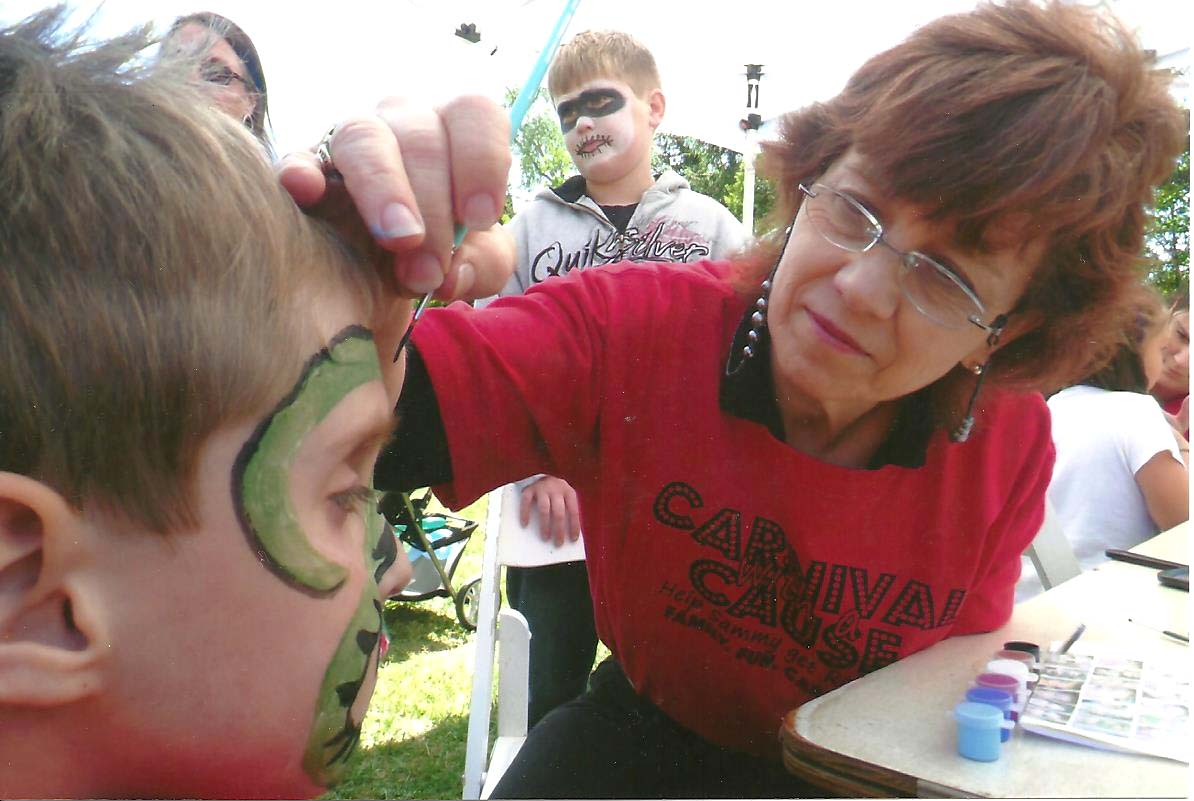
My young artist friend asked for a snake to be painted on his face.
My friend here loves art. I’m not a great face painter but he was encouraging and kind and appreciated the snake that wrapped itself around his eye and slithered around until the forked tongue came down his chin. My young artist friend has spina bifida and life has handed him some stiff challenges. But he meets adversity with optimism, bravery and with the trusting faith of a little boy. God definitely gave him the right parents and the family has inspired our whole community! My young artist friend is bright and has interests that any other seven-year-old boy. He particularly likes black, painting cars and turkeys, since he and his dad go turkey hunting together. What really stands out about his art is how much he enjoys the experience. It is a part of who he is, and it brings a smile to watch his approach to life. Speaking of smiles, he has a terrific one.
The idea that limitations can spark creativity is fascinating. I think of the “Greatest Generation” who struggled through the Great Depression and came of age in the World War II era and how creative they were and are. Life handed them many limitations, and now succeeding generations have named them “The Greatest” because they learned to leverage those limitations for good. Individuals I know from this era understand way more than my generation how to do with less and create solutions to problems from practically nothing. They have been among my greatest encouragers. I stand in awe.
CIVA (Christians for the Visual Arts) showcased this video on this amazing artist whose creativity soared as a result of his physical limitations, and this inspiring clip is well worth the time for the innovative thoughts it is bound to start in you. Enjoy!
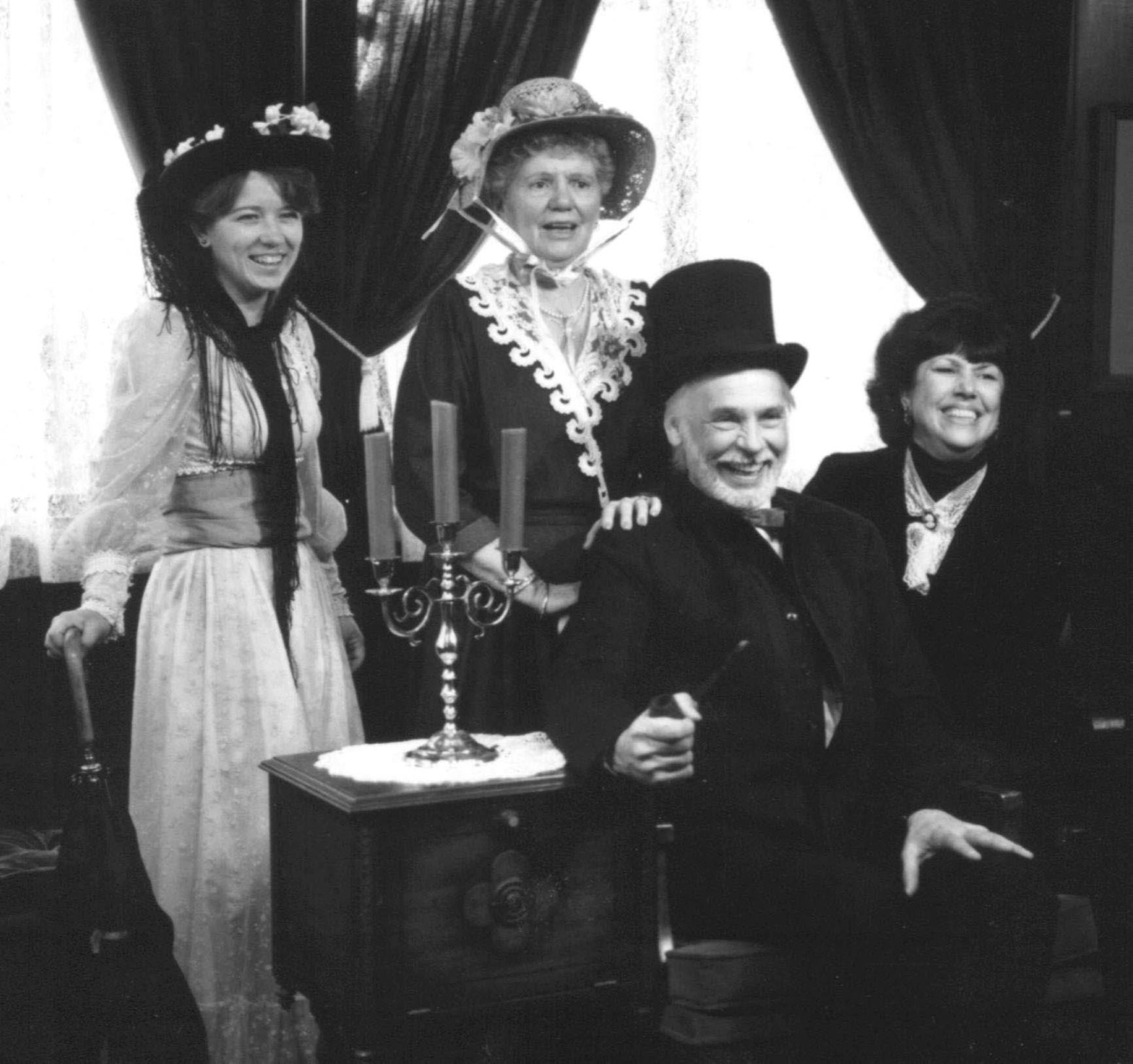
Members of the Representational Art League hold a show at Mc Diarmid’s Prairie Gallery in the late 1980’s. Front counterclockwise: Jim Faber, Karen Doyle, Francis Bravo, Penny Fregeau
Back in the day, as they say, I was part of a small band of artists working in a representational manner. We called ourselves The Representational Art League, and although my path went a different direction, the League is still in existence. We started something called Art & Wine in the Park in local Rohner Park to showcase and celebrate the work of local artists. It was mostly art and a little wine. Now, as I restart my art career, I again entered the event as an artist and as I look at the current advertising these many years later it appears to be mostly wine and a little art. I hope not – I would like to see some balance there but regardless, I shall enjoy being in a community event where I have the opportunity to meet a lot of new people and find out what kind of art resonates with the attendees.
The day is Sunday afternoon, June 9th from 12-4 at Rohner Park in Fortuna. The event itself is free. It starts costing if one picks up a wine glass or takes a liking to a piece of art. Most artists I know try to offer a range of items from inexpensive to labor intensive higher priced items. The term ‘starving artists’ means that the majority of artists know what it is like to have a season of life that is lean economically. Hopefully, everyone can enjoy seeing some art and having some good conversation in any season of life.
If you are traveling through the beautiful and wooly woods of Humboldt County in Northern California, be sure to come by the park. Enjoy!
I painted this many years ago remembering my little girl’s first day of school.
When we work with passion there is a quality that draws people. We may or may not equate with the subject of the passion, but people tend to appreciate someone who is enthusiastically working with their heart and soul. It is evident, it shows.
May years ago I submitted a painting (there is a detail of it, above) to a juried show. The juror did not know me, nor my family. The title of the painting did not give away the fact that I had a relationship with this little girl. The juror’s comment was “in the way this work is painted, it is obvious that the artist loves this child.”
What makes this obvious? I’ve stared at the painting many times since then wondering what she saw. How did she know how much I adored my daughter? It has to do with passion, and that sometimes indescribable quality that permeates that in which we put our heart into fully.
Passion takes something from ordinary to extraordinary. Passion moves us through things that would tend to slow us down or discourage us…to keep us fired up until we reach the other side. Passion is a fuel, a hope, and a magnet that attracts others to that which we find so utterly inspiring and significant.
I have a passion for the arts, for painting most significantly, and creative expression on many levels. But far greater is a passion that burns inside of me that gives me a purpose for my passion. And that is to communicate how deeply God loves us, shown most dramatically through the life, death and resurrection of Jesus Christ. His example of living a life of passion exceeds all others and daily I am moved, in some way, to share this life transforming truth through creative means…passionately!





 penfrea. com Nehemiah's Art