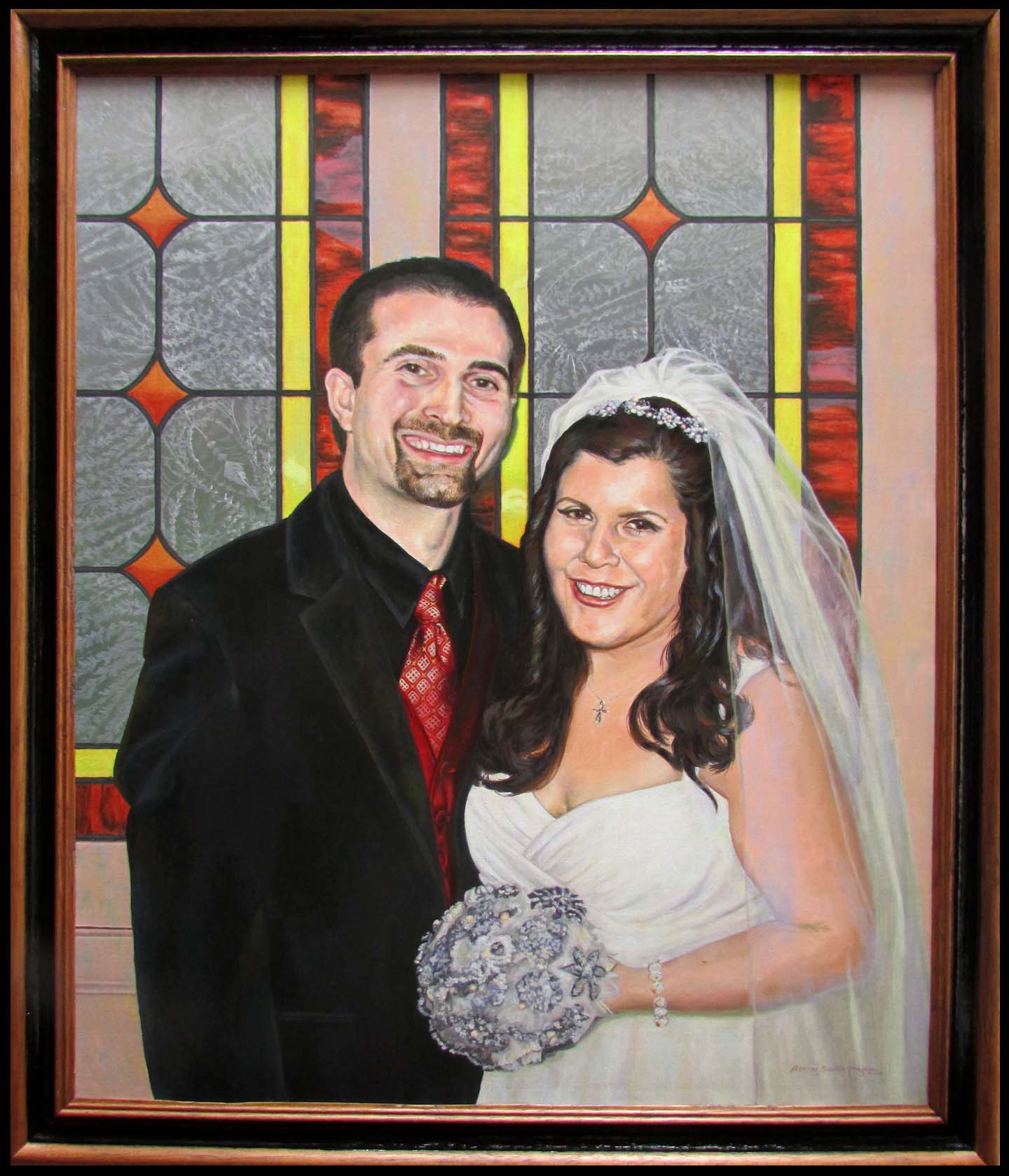
Adam and Barbara chose a special place for their wedding. Adam, as he grew up, was very close to his grandfather. Adam’s late grandfather was a dedicated Trustee for many years in his home church. He made the baby cribs, crafted the wooden cross in the sanctuary and gave over fifty years of service. He helped to keep the church building a warm and comfortable place for families in the community. All six of their children grew up at that church. As a young adult the youngest daughter and her husband crafted the stained glass windows for the sanctuary. Adam’s grandpa made the wooden windows that presented the pieces of glass art.
On December 7, 2012, Adam and Barbara promised their lives to each other in this location, surrounded by an environment of family memories.
When I was asked to paint their portrait, I was thrilled. As I painted I recorded each days work in photographs and so the result is a video that takes the portrait from a detailed drawing to the finished framed canvas with process notes a long the way.
Here is the video:
The artist (myself) is also the daughter who made the stained glass with her husband. I feel very honored to be a part of this wedding memory for Adam and Barbara, my nephew and new niece. God bless your happy marriage!
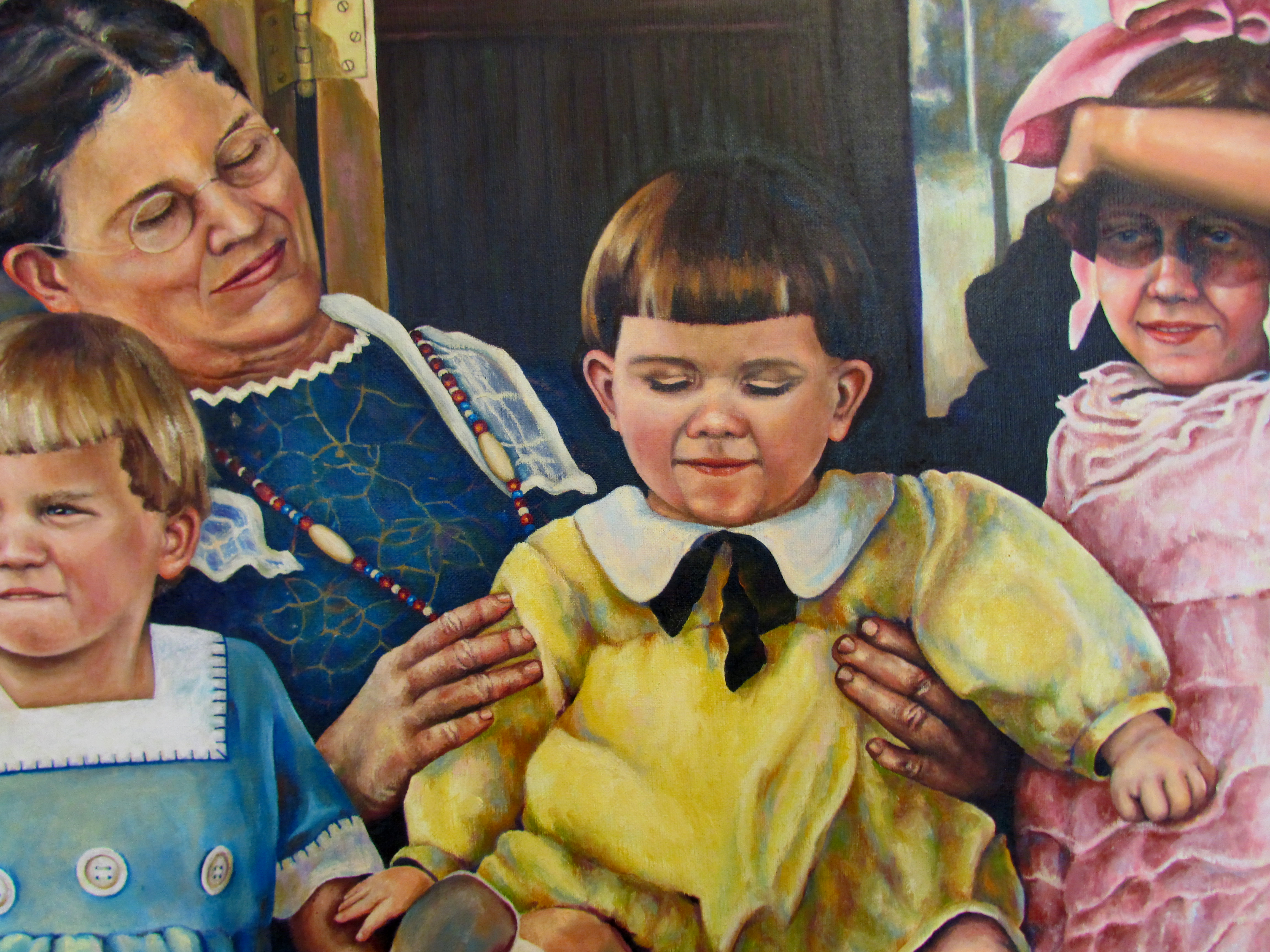
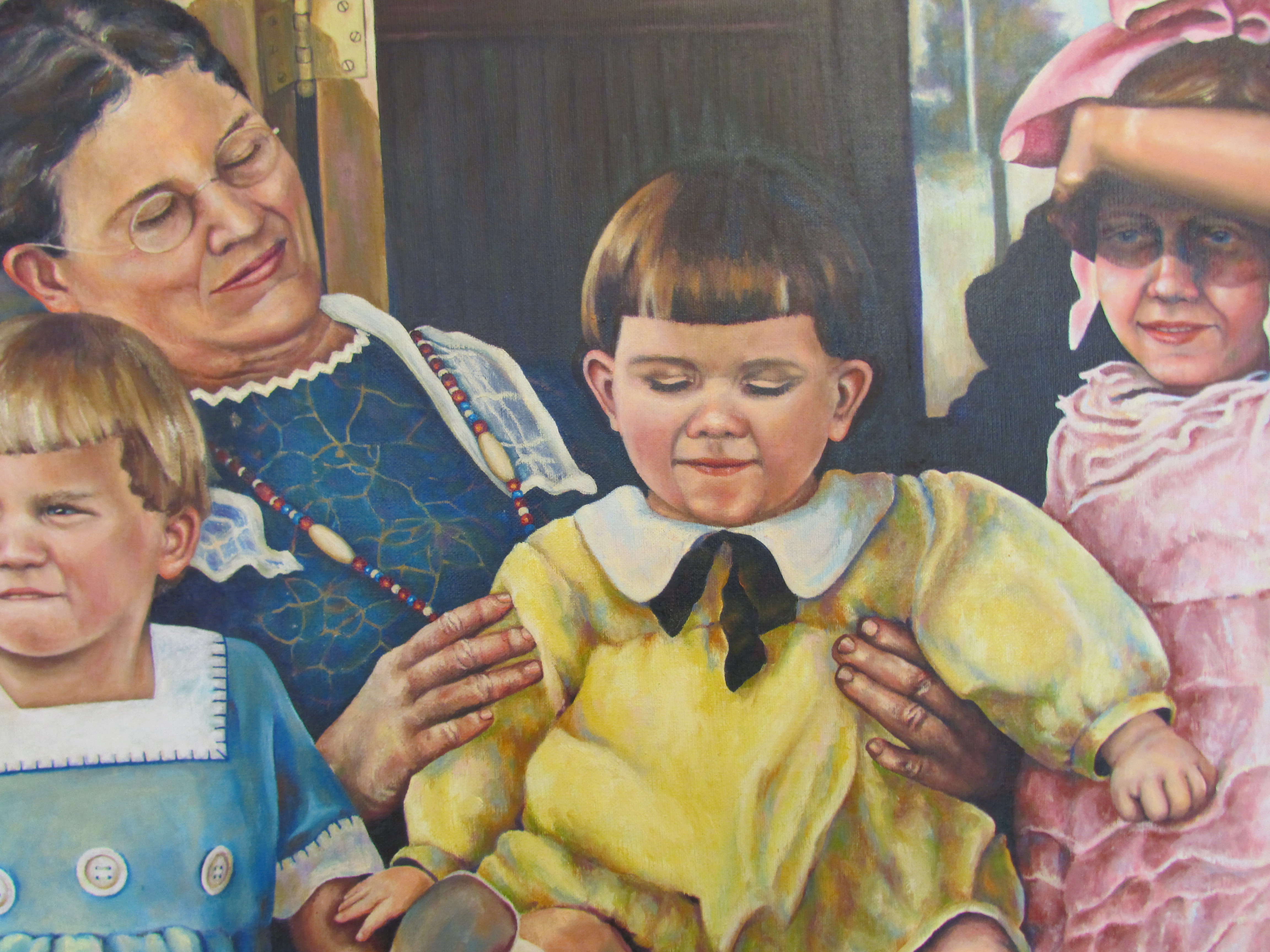
A detail of a painting set in the early 1900’s. Notice the many colors on the sole of the baby shoes. This detail of a larger painting is of a baby (an uncle of mine) named William whom I renamed “Charlie” when I was a little girl. Uncle Charlie fit his comical personality better. Sure do miss him.
In last night’s Colored Pencil Drawing Class the subject was shoes. The students did a great job bringing all kinds of footwear to artistic life.
When we think of shoes there is what we call the sole of the shoe. The word ‘sole’ or ‘soul’ is used in a couple of different ways. In ministry ‘soul’ is used to describe the spiritual part of a person which is distinct from the physical body. In art, the term ‘soul’ is used to describe a quality of work. For example, “that painting has a lot of soul.” It means that there is an esoteric quality that gives an artwork a deep or thoughtful essence. It is not just a surface representation of an object or a person but communicates more than meets the eye. A great example would be the famous Mona Lisa. People have been speculating about who she was and what was behind that mysterious smile for hundreds of years.
There is more to art than creating beauty. Your work shares a part of you and a message about your outlook on life. So if you want to create great ‘soulful’ art, then also see that you are attending to your own soul.
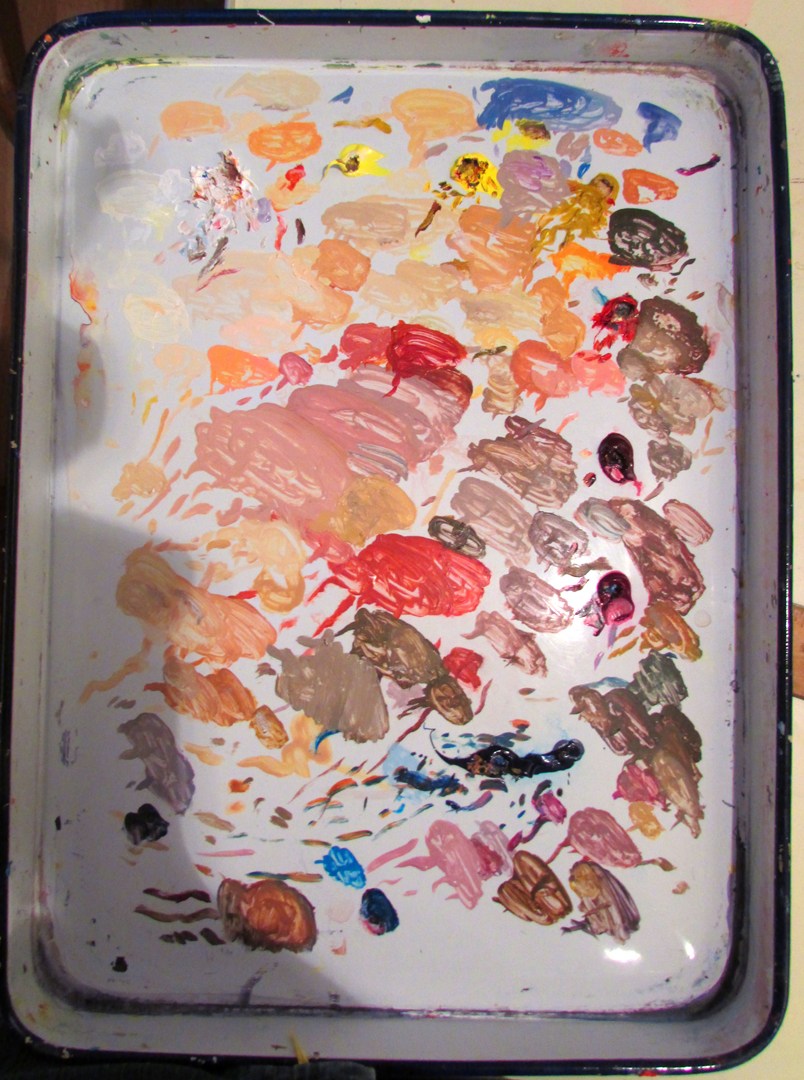
There is a sense of exhilaration as a painting, in this case a wedding portrait, nears it’s completion. The many hours spent before the easel has something tangible to show for the effort. There are jars full of various brushes and daily pallets which if seen all together would have hundreds, if not thousands, hand mixed dabs of paint. The mixed paint on the enamel plate that I use for a palette in itself is an interesting composition. One can view the limited colors which appear on every palette and the characteristic squiggle marks as I manipulate the tiny brushes loaded with paint to a certain viscosity for the needed brush stroke.
Some jobs require a high degree of multi-tasking, rapid pace, stress and pressure built into the mix. The “job” of painting portraits has its own pressures and brain gymnastics to be sure. But there is also sheer pleasure and delight in the mixing, the observation, taking in moments of beauty, applying of paint and experiencing the wonder of seeing images come to life. The creative process is in itself exhilarating.
I am thankful for this season of life in which I am able to paint. It is its own work, but it brings me joy. We do not know what lies ahead, but for this day I will enjoy having just a taste of being allowed this magnificent pleasure.
All human beings are creative because we are made in the image of the GreatCreator. What aspects of creativity do you enjoy? In what activities do you feel God‘s pleasure? Have you had to put off times of creativity for a season? If so, have you found that when you do have the opportunity to step back into that process that you enjoy it exponentially more? That is my experience, and may it be yours as well. Happy creating!
One of my more “painterly” works influenced by my color theory teacher and Impressionism.
The French Impressionists, in finding freedom from the use of pig bladders, discovered a modern advance that enhanced time-honored practices in the making of paintings. Contemporary artists, even those who paint in a very traditional manner, continue to find ways to use things like social networking and other technologies to bring to life new images as well as replicas of ancient subject matter.
The Smithsonian magazine (May 2013) explains that before the invention of the tin tube by American portrait painter John G. Rand, artists would laboriously mix oil paints and put them in pig bladders to keep them from drying out. At the start of a new painting day the artist would use a tack and put a hole in the pig bladder to squeeze out the paint. But besides being messy, there was no way to recap the bladder. Expensive paint would dry up and the output of labor meant artists would only use a few colors at a time. That is until the tin tube Not only would the paint keep longer, artists could carry more colors and go outside to paint those vibrant landscapes. A modern advance (tin tubes) had a big impact on the art history.
When I was pursuing my art career back in the 90’s, I used photographs as reference material. Artists have done so ever since photography became commonplace. Then as ministry became a focal point of my life I stayed out of my studio for the better part of fifteen years. When I returned to my studio this past February I found new tools at my disposal. Photo editing software such as Adobe Photoshop has allowed me to work through some pictorial problem solving before a brush touched my canvas. Taking photos in the process of creating the painting allows ways for me to evaluate my progress and have an added perspective in critiquing my work. Sharing artwork on social networks such as facebook, twitter and even this blog site allows opportunity for feedback which has been very helpful in discovering what resonates with individuals.
Some things never change. King Solomon said there is nothing new under the sun. The time-honored practices of producing art still makes for quality art work. Yet, God gives us the magnificent gift of creativity and innovation to enhance those traditional practices and push the limits of new technologies and ways to celebrate our visual world and give honor to the One who created it.
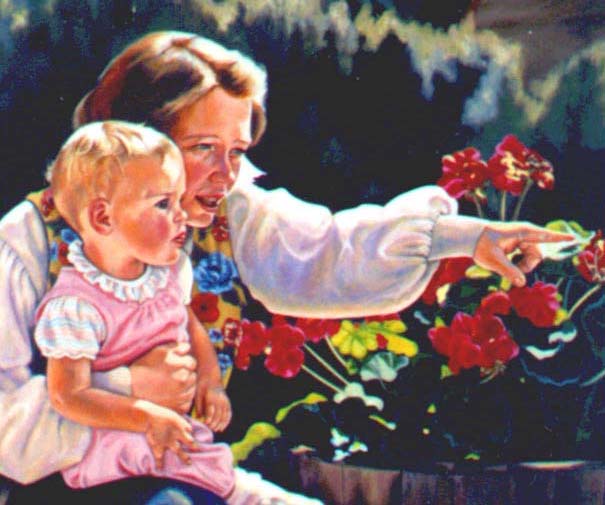
Detail from a painted family portrait – early 1900’s by Penny Saville Fregeau
I recently ran across a wonderful blog called I Am A Child – http://iamachild.wordpress.com/. After viewing several of the paintings from the pages of art history of painting after painting depicting children, I recalled how much I love these images. We are blessed to have a five year-old with us in this season of life. Again, I can re-live the wonder and enjoy learning through her innocent eyes. Painting portraits and scenes with children as the main subject allows me to soak in the treasure that children are and have been throughout time.
English: Anders Zorn’s painting Modersglädje (Photo credit: Wikipedia)
I read a great book some time back called Heaven is for Real by Todd Burpo. Through the retelling of the author’s young son’s experience while acutely ill, a phrase was repeated over and over. He would say, Jesusreally really loves children. This little boy came back from the hospital with memories of heaven, of relatives and many details that no one could have known otherwise. But in the weeks, months and years after the little boy was adamant about one point: that children are precious to Jesus.
Christ Blessing Little Children (Photo credit: Wikipedia)
The children in the painting above were (left to right) my father, my Uncle “Charlie” and an aunt who died when she was only 15 – Penelope. They had just lost their mother – aged 23 – from the influenza epidemic that swept through in the early 1900’s. They sit with their grandmother – a candid pose – and I just wonder what is going through their young minds.
Children held a special place to my father (I’m the youngest of six). He was an engineer by trade, but he loved making children’s toys so much that on his grave marker we had:
Husband, Father, Grandfather, Toy Maker
Like the little boy said, Jesus really really loves children.
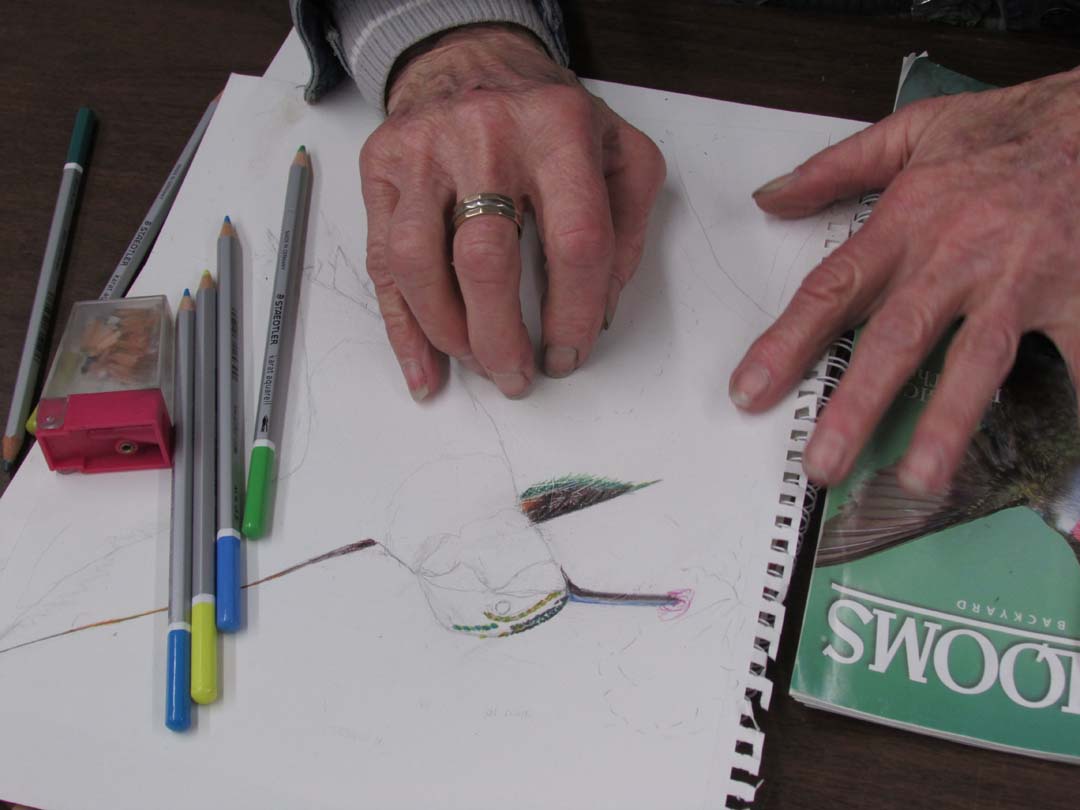
A young art student draws a variety of hand sketches.A student of retirement age draws the likeness of a hummingbird.
It is exciting to see someone’s talent bloom in any season of life. For many, it is not until the years of retirement that the schedule allows some time to address a life long yearning to study art. My grandmother, for example, did not take up painting until she was in her eighties (she lived to be 100). She raised seven children, and many of those years she did so as a single mother. At night she would cut out horses in silhouette to entertain her little ones before they went to sleep. Raising seven children is an art in itself!
Some however are blessed with parents that provide encouragement for their artistic endeavors from an early age. Such is the case with the student above. I was blessed tremendously in this way myself. I wish I could give encouraging parents an award because the positive words they speak into their children will have life-long positive results.
The young student-artist is not only learning how to represent something visually or to express their own individuality and creativity. These student-artists they are learning problem-solving abilities that far outrun the boundaries of art. Solving art problems are like push ups for the brain!
Rainbow pencils (Photo credit: @Doug88888)
In addition, classes like this one for Colored Pencil Drawing allows an interaction of generations that is so rich. The students in this particular range in age from 12-70(ish). I say “ish” because I do not ask the age of adults. They give and take in their conversations, and building up of one another’s confidence to keep on trying. It is a delight to witness, and another reason that I love to teach art.
A painted detail from a wedding portrait that features stained glass in the background.
They drove up en mass to our stained glass studio. I smiled because people usually made an appointment as we left the shop at times to install our stained glass windows in the cities in and around Orange County in Southern California. I’m glad we were there when they came. They were a committee of ten – people from my childhood. The church where I had grown up had contracted with us to purchase some stained glass windows for their sanctuary. I was very happy for it meant more than a job, it meant more than making art – this place and these people were part of a sacred history for me.
The jolly gentleman in charge was someone everyone knew and respected. He had led the youth groups long ago and now in his senior years he was purchasing this stained glass for the church in memory of his late wife. I only remember her in a wheelchair, how devoted he was to her, and that I was always offered fruitcake when my father and I went to visit their home. That was before my taste matured to appreciate fruit cake.
There was the tall couple from the choir. His head was bald and shiny and in my memory I always remember a certain glare, for I must have seen him under the lights. His wife had one of those peuffy 60’s hair – dos. I think she sang soprano. There was someone who was kind of fussy, but I don’t remember what she looked like, only what she said. And then, among them was the sweetest kindest lady named Skip. She was my Sunday School teacher in kindergarten. I loved her.
The committee of ten came to select colors for the stained glass windows to adorn their sanctuary. The stained glass design they had picked was very simple – so only four colors were needed. We had ten people to pick four colors. Are you starting to get the picture?
Well they bantered back and forth about what combinations would be best. I remember someone stating emphatically that they had just painted the sanctuary peach. I think it was the grumpy lady and she seemed a little unsettled that our glass selection, (which was from all over the United States and Europe mind you) didn’t include peach. I sheepishly offered that the stained glass, which could last for hundreds of years, would outlast the paint job and perhaps they should consider decorating around the art, which in this case was the stained glass.
One of the committee members then considered the combination of red and yellow for the accent pieces in the glass. Other committee members nodded in agreement until the grumpy lady proclaimed, “those are Catholic colors!” Did I mention this was a Protestant congregation? I must have looked a little aghast, and bewildered. For one I didn’t think it was true, and even so, so what? My kindly Kindergarten Sunday School teacher leaned over and whispered in my ear, “I think they are all God’s colors.” I smiled. There was one more reason for liking this dear lady.
Well the committee finally came to agreement. I made a note to self. Never, no never allow ten people to make a decision on four colors. For people making a decision on ten colors would be hard enough. Ever since then, I have always liked the idea of small committees, or rather teams, to make such decisions.
The moral(s) of the story?
Decorate around the art. The painting and furnishings will change. Art can last for generations.
Be very intentional about who and how many to make decisions.
All the colors are God’s colors – forever and ever, Amen.
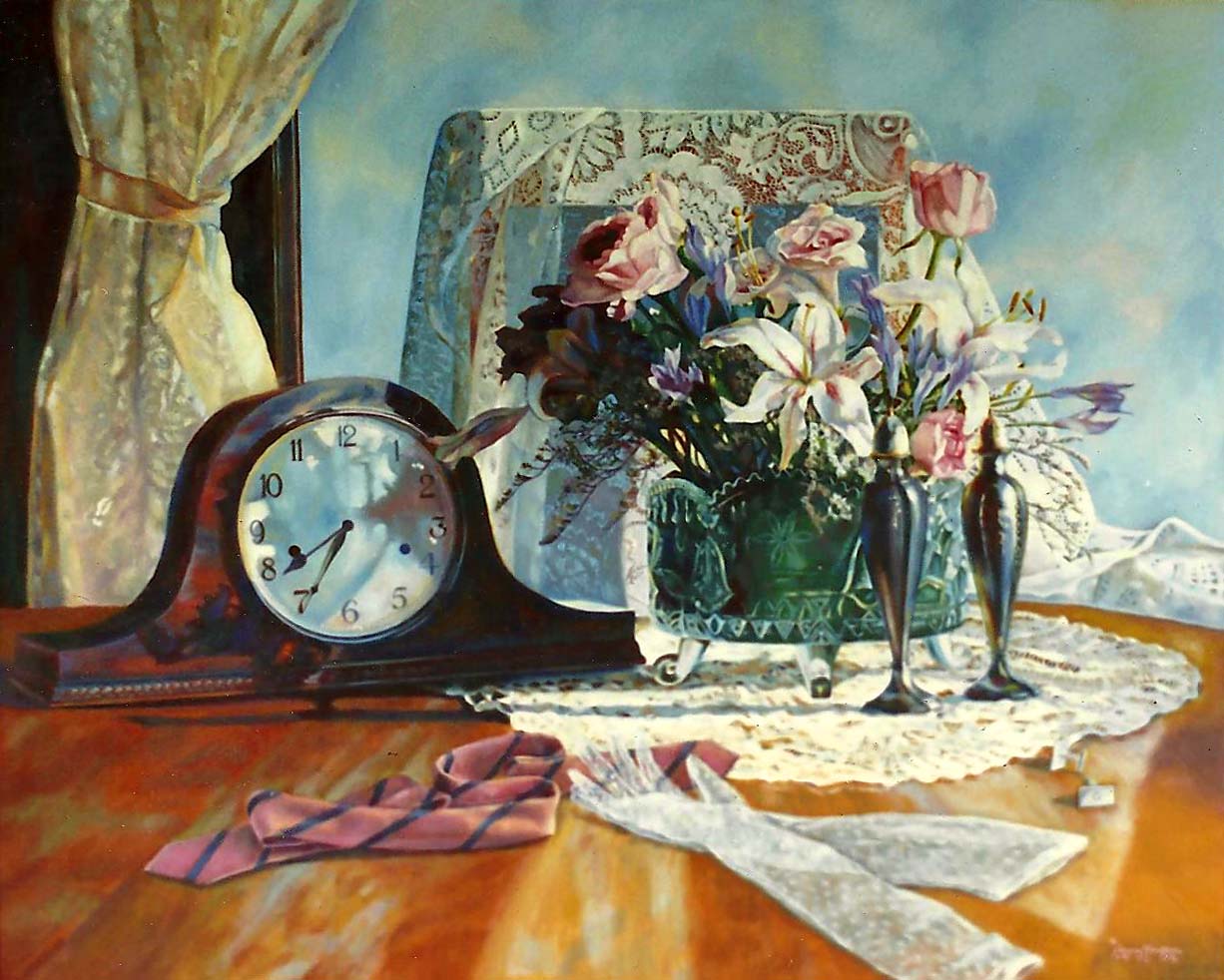
This wedding-themed painting features some subjects like lace and cut crystal that may seem difficult to paint.
Some subjects freak people out. When faced with trying to draw or paint someone’s likeness or a panoramic view or a complicated (or seemingly complicated) object the “I can’t do this” thoughts can fog our brains. This is when we need to take a step back and literally forget what it is we are trying to artistically interpret and look simply at the visual information of what we see. Here are some questions to ask ourselves:
What are the main geometric shapes that are before me?
Are there shapes I need to make more pleasing to the eye?
What can be omitted?
As my color theory teacher, Jim Faber, used to say:
Forget what you think you see and tell me what you really see.
We can get caught up in the enormity of the task. But simply putting the brush to the canvas, asking ourselves some questions to see the subject from a different perspective, and going forward one stroke at a time yields some exciting results. Things that look very complicated, like the lace above, really are not all that different to paint from something simple looking like the groom’s tie. It’s a matter of rethinking, and taking it one step at a time.
Life Application:
Reinhold Niebuhr wrote a beautiful prayer we commonly think of as the Serenity Prayer. This prayer, like the principle above, causes us to look at the subject from a different perspective. In this case, it is life itself. The prayer is deep with meaning and is recited at Celebrate Recovery meetings for this reason: if one really seeks God about putting these words into practice the results are life-transforming. Here is the original version:
God, give me grace to accept with things that cannot be changed,
Courage to change the things which should be changed,
and the Wisdom to distinguish the one from the other.
Living one day at a time,
Enjoying one moment at a time,
Accepting hardship as a pathway to peace,
Taking, as Jesus did,
This sinful world as it is,
Not as I would have it,
Trusting that You will make all things right,
If I surrender to Your will,
So that I may be reasonably happy in this life,
And supremely happy with You forever in the next.
Complimentary colors – the opposites on the color wheel, make for a visual ‘zing’ in a painting.
In my early twenties I was taken back by learning that someone with whom I had attended High School was studying color theory for an entire year at his chosen university. I shook my head and could not comprehend that one could fill a whole year’s studies on color! Yellow and blue make green, right? How could there be that much to know? At the time I was busily engaged in creating a lot of stained glass windows. Our company, Fregeau’s Glass Works, was making hundreds of windows and I was actively involved with the color aspect of each one. We worked with many interior designers and wealthy clients. Stained Glass was, after all, a luxury. I had taken a lot of art classes and grew up with an artist mother – a wonderful painter. I could not fathom that there was that much to learn about color.
Color star based on Charles Blanc color star. English Version (Photo credit: Wikipedia)
I was very wrong.
I was a couple of years into my painting career when I saw someone’s paintings at a local show, and there was such a depth and maturity in his work that I recognized there was something about paintings that I just didn’t know that he evidently did. And so I asked him for lessons. The main ingredient I was missing? A knowledge of color… color theory is the term.
And so began a learning curve that has yet to quit. God made a world filled with color and light. This truth permeates every painting.
Color galaxy (Photo credit: @Doug88888)
When the Impressionists came out of their studios into the light of day to paint, their experience with discovering color was “like scales falling off the eyes.” We hear such dramatic imagery from the Bible when the Apostle Paul was blinded on the road to Damascus, but when he again received his sight, the scales fell off. Seeing and understanding color was so dramatic to the Impressionists that they used like terms.
English: Their are thousands of artworks created in the art world depicting St Paul. This painting was created by the famous artist called Rembrandt. It hangs on the walls of the National Gallery of Art, Washington DC (Photo credit: Wikipedia)
The key? Observation. Look and look and look and look. Don’t paint what you think you see. Paint what your eyes tells you that they see. And when it comes to color, that is quite a lot.
A painted Easter lily, detail from Resurrection Lilies
I love to paint. I love to discover over and over again the exquisite detail in a multiplicity of forms. Observing the delicacy of a flower, the delight of a child’s smile and the twinkle in an older person’s eye reminds me of how much The Great Creator obviously loves detail! God created a beautiful world filled with color and light. He lavishes the world with millions of particles, forms, lines and colors to create unspeakable beauty in nature. And then to top it off, He created human beings with the utmost care, dignity and incomprehensible love – taking obvious joy in the very shades of skin. As the Sunday School song declares red and yellow black and white, they are precious in His sight. God obviously loves diversity!
God the Father 16 (Photo credit: Waiting For The Word)
Every time I start an art class we begin by doing exercises to increase our ability to observe the world around us and increase our awareness of natural beauty. It all makes a connection in my mind. If God cares so much about the detail in a flower that is in bloom for only a few days, how much more does He care about the details in my life? And so studying art makes me feel greatly loved!
Having a day when you are feeling insignificant and lost in the shuffle? Check out those flowers, observe the world around you quietly. Notice the intricate design in nature. See how many forms have both random patterns yet characteristic qualities that bind it together. Amazing, right? All of nature points to a Great Creator, and if so much intelligence and design went into something very tiny, consider what that means for you. May you be encouraged today!













 penfrea. com Nehemiah's Art